
CBSE’s Biggest Reform in Years: What the New Twice-a-Year Board Exams Mean for Class 10 Students

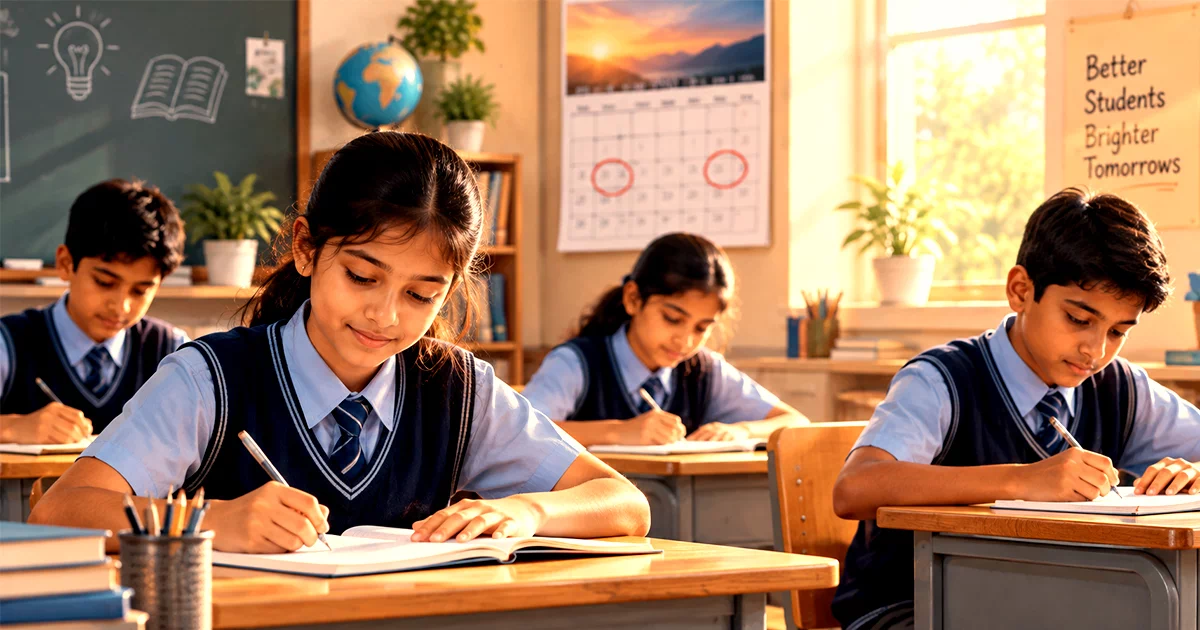
For as long as most current parents can remember, the CBSE Class 10 board exam has meant one thing: a single, high-stakes exam at the end of the year that could make or break how a student’s entire academic record looked. Starting with the 2026-27 academic session, that changes. CBSE is rolling out a twice-a-year board exam system for Class 10 — and it’s one of the most significant structural shifts to Indian school assessment in years.
How does the new system actually work?
Under the new structure, Class 10 students get two board exam attempts within a single academic year instead of one. The first round is expected to be held earlier in the year, with results declared by March. A second round would follow in May, with results expected by June. The gap between the two exam windows is reportedly being kept tight — potentially as little as a day between subjects in some cases — specifically so both rounds can be completed and results declared within the same academic year, rather than the process dragging into the next one.
The Education Ministry has asked CBSE to release a draft framework for public feedback as part of rolling this out, and the plan is to start with Class 10 before a similar two-exam model is considered for Class 12 — so for now, this is specifically a Class 10 change, not something Class 12 students need to plan around yet.
Why is CBSE doing this?
The stated reasoning ties directly back to the National Education Policy 2020 and the National Curriculum Framework 2023, both of which have pushed for reducing the single-shot, high-pressure nature of India’s board exam system. The core idea is straightforward: a student who has a bad day, falls sick, or simply underperforms in one attempt gets a second, genuine chance within the same year, rather than that one exam permanently defining their academic record. It’s a shift toward giving students more than one shot at showing what they actually know, instead of treating a single few-hour exam as the definitive measure of a full year’s learning.
Other changes rolling out alongside this
The biannual exam isn’t the only structural change coming to CBSE this academic year. The board is expanding its dual-level subject system — where students can choose between a “Standard” and a more advanced level — beyond Mathematics, where it’s already been in place, to now include Science and Social Science for Class 10 as well. This gives students more flexibility to choose a difficulty level that actually matches their strengths and career plans in more subjects than before, rather than being locked into a single difficulty tier across the board.
CBSE is also introducing a Global Curriculum for its foreign-affiliated schools — roughly 260 CBSE-affiliated institutions outside India — starting this academic year. According to reporting from the Times of India, this curriculum is designed to integrate core Indian subjects into international classrooms while maintaining CBSE’s existing educational standards, extending the board’s footprint and consistency across its international school network.
What this fits into: the bigger NEP rollout timeline?
This reform doesn’t exist in isolation — it’s part of a broader, multi-year National Education Policy rollout that’s been unfolding in stages. The 5+3+3+4 schooling structure (a restructured approach to how school years are grouped, replacing the older 10+2 model) was fully rolled out across CBSE and state board schools in the 2025-26 session. The current phase, running through 2026-27, is focused on expanding digital learning infrastructure — platforms like NDEAR and smart classrooms — to roughly half of government schools nationally. Looking further ahead, vocational training is slated to become mandatory in secondary schools by 2027-28, with the policy’s longer-term targets aiming for 100% gross enrollment in school education and 50% gross enrollment in higher education by 2030.
Separately, and worth knowing for anyone tracking accountability measures alongside these flexibility-focused reforms, the “No Detention Policy” — which had previously prevented schools from holding students back a grade regardless of performance — has been scrapped as part of the broader NEP implementation, a change aimed at reintroducing some level of accountability into the system even as the exam structure itself becomes more flexible and less high-pressure.
What should parents and students actually do with this information?
If you have a child currently in Class 9 heading into Class 10 for the 2026-27 session, this is worth understanding now rather than waiting for the exam year itself, since it changes how the year’s preparation timeline is likely to be structured — with two distinct exam windows to plan study schedules and revision cycles around, rather than one long build-up to a single exam period. CBSE has indicated the detailed framework is still being finalized following public feedback, so exact subject-wise scheduling and specific rules around how the two rounds interact (whether a student can choose their better score, retake specific subjects, or must sit both rounds in full) are worth checking directly on CBSE’s official website as the framework firms up, rather than relying on early reporting alone.
For families with children in the dual-level subject system, it’s also worth having an early conversation about which level — Standard or the more advanced option — genuinely fits your child’s strengths in Science and Social Science now that the choice extends beyond Mathematics, rather than defaulting to whichever tier feels safest without weighing it against actual career and stream plans ahead of Class 11.
The bottom line
This is a genuinely significant shift, not just an administrative tweak — CBSE is fundamentally rethinking how much weight a single exam day should carry in a student’s academic record, and pairing that with more subject-level flexibility and international curriculum expansion in the same academic year. Whether it succeeds in actually reducing student stress, which is the stated goal, will depend heavily on how the finer details of the framework — retake rules, scheduling gaps, and how results from both rounds combine — actually get implemented once CBSE finalizes them.
This reflects the reform plans reported as of the time of writing. Exact implementation details are still being finalized by CBSE — check cbse.gov.in for the official, confirmed framework before making academic planning decisions.