Skill India at 10 Years: 7.67 Crore Trained, and What’s Actually Changing for Students Now

While CBSE’s exam reforms and board results tend to dominate education headlines, a much larger, decade-long transformation has been quietly reshaping what “education” even means for millions of Indian students — one focused less on exam scores and more on whether students actually leave school with usable, employable skills. As the Skill India mission marks roughly a decade in operation, here’s where things actually stand, and what’s genuinely changing for students right now.
The scale, in real numbers
Skill India’s headline figure is substantial: 7.67 crore people trained since the mission’s launch, according to reporting on the programme’s decade-long progress. The physical infrastructure behind that number is considerable too — 44.8 lakh students are currently enrolled across India’s Industrial Training Institutes (ITIs) as of 2026, and the government has committed a fresh ₹34,000 crore push for the programme’s next phase.
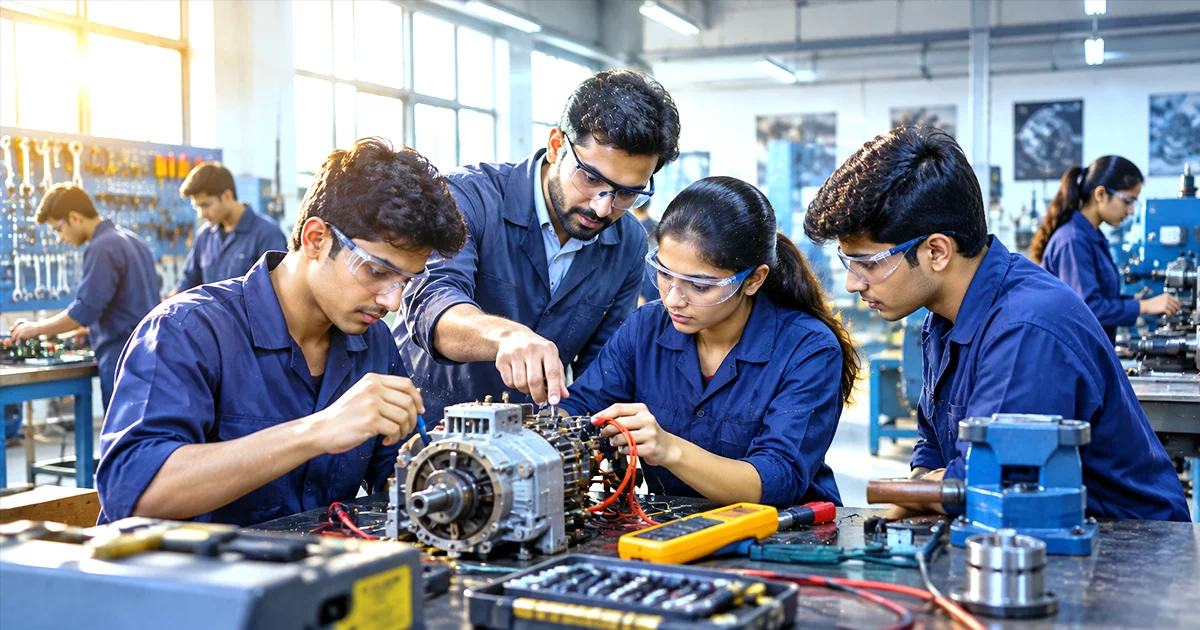
That funding flows primarily through PM-SETU — the Scheme for Skilling and Employability Transformation through Upgraded ITIs — which the government is running as a ₹60,000-crore initiative specifically to modernise the ITI network and align it more closely with actual industry needs. The government has been actively calling for greater private industry participation in PM-SETU, on the reasoning that ITIs training students in skills that don’t match what employers actually need defeats much of the programme’s purpose.
What’s actually different for students now: Kaushal Tracks?
Here’s the structural change most likely to actually touch a student’s day-to-day education. Under a new framework called Kaushal Tracks, structured vocational specialisation can now begin as early as Grade 9, with up to half of the Grade 11-12 curriculum available in a chosen trade rather than the traditional, fully academic stream.
The genuinely important detail sits in how this credit is treated afterward: under the National Credit Framework, a skill certificate earned at the school level now carries forward into a diploma or degree program, rather than existing as a standalone credential that expires or doesn’t count toward further education. That’s a meaningful shift from how vocational training has traditionally worked in India, where a school-level skill certificate and a university degree existed in almost entirely separate, non-transferable tracks. A student who picks up a trade skill in Grade 9 under this framework isn’t necessarily choosing between “academic” and “vocational” paths permanently — the credit can follow them into higher education later if they choose that route.
The problem this is actually trying to solve
The scale of what’s driving this push is worth understanding directly. NITI Aayog reported this year that 8.7 crore Indians aged 15-29 are currently out of education, employment, or training entirely — a category often referred to internationally as “NEET” youth (not to be confused with India’s NEET medical entrance exam). NITI Aayog’s own report specifically called for stronger vocational education and apprenticeships as a direct response to this gap.
That’s the real backdrop against which Skill India’s expansion is happening: not simply an effort to make school more “practical” as a general educational philosophy, but a fairly direct response to a genuinely large population of young Indians who’ve fallen through the gap between finishing school and actually finding employment or further training.
State-level changes worth knowing about
Individual states have been moving at their own pace, and a few specific changes stand out. Bihar made a genuinely notable shift this year: the state now replaces “Fail” with “Eligible for Skill Development” on Class 10 and 12 marksheets — a change explicitly designed to route students who don’t clear board exams toward vocational training rather than simply marking them as having failed with no clear next step. Whatever one thinks of the framing, it’s a concrete example of how the skilling push is starting to reshape institutional language and structure around academic failure, not just add new elective options for students already succeeding academically.
Tamil Nadu is introducing AI and machine learning trades across 50 government ITIs over the next five years, expected to benefit around 24,000 students — a genuinely significant bet that foundational AI skills belong in vocational training, not just university computer science programs. Odisha’s CHSE board approved two new vocational courses for Plus-II students this month, and Jammu and Kashmir is working to transform its ITIs into what’s being called “industry-ready skill hubs” under the PM-SETU framework, with modernised infrastructure and stronger industry linkages.
The international dimension
Skill India’s ambitions aren’t purely domestic. At the BRICS 2026 forum, education, technical and vocational education and training (TVET), and skills forecasting were placed at the centre of regional cooperation discussions — reflecting a broader push to align India’s skilling framework with international standards and opportunities. India’s continued participation in WorldSkills competitions (with WorldSkills Shanghai 2026 among this year’s events) serves a similar function, benchmarking Indian vocational training against international competitors in specific trades.
There’s also a more direct international employment angle: India and Japan have been developing a planned employment corridor intended to place up to 50,000 Indian workers in Japan, though reporting has flagged a genuine obstacle — a Japanese-language skills gap among Indian workers that could slow how quickly that pipeline actually delivers job placements, regardless of how strong the underlying technical training is.
What this actually means if you’re a student or parent?
If your child is entering Grade 9 or above, it’s worth directly asking their school whether Kaushal Tracks or an equivalent vocational specialisation option is available, and if so, what specific trades are on offer locally — availability varies significantly by state and by how far individual schools have progressed in implementing the framework. The credit-transfer element under the National Credit Framework is the detail worth confirming specifically, since it’s what actually determines whether a skill certificate earned now will count toward something later, rather than functioning as an isolated credential.
For families weighing whether a vocational track represents a genuine opportunity or a lesser option compared to a purely academic path, the honest answer depends heavily on execution at the specific institution — a well-resourced ITI with real industry partnerships and updated equipment offers something genuinely different from an under-resourced one offering the same credential on paper. Given how unevenly this rollout is proceeding across different states, it’s worth researching the actual quality and industry connections of a specific institution rather than assuming the national statistics apply uniformly everywhere.
The bottom line
A decade in, Skill India has built real scale — tens of millions trained, a substantial and growing budget, and a genuine structural shift toward making vocational credentials portable rather than a dead end. Whether it closes the gap NITI Aayog flagged — 8.7 crore young Indians currently outside education, employment, or training — will depend less on the national numbers and more on how consistently states like Bihar, Tamil Nadu, and Jammu and Kashmir actually execute on the ground over the next several years.
Programme details, state-level implementation, and funding figures are subject to change as this initiative continues to develop. Check the Ministry of Skill Development and Entrepreneurship’s official channels for the most current information.