Yojana 2026: Eligibility, New ₹5 Lakh Loan Benefit, and the 6-Crore Target Explained

The government hit its original Lakhpati Didi target a year early — and instead of slowing down, it doubled it. As of the latest official update, more than 3.46 crore women have already been certified as Lakhpati Didis, and the goal has now been raised to 6 crore by March 2029. If you’re part of a Self-Help Group, or thinking about joining one, here’s exactly what changed in 2026 and what it means for you.
What is Lakhpati Didi Yojana?
Lakhpati Didi is a Government of India initiative under the Deendayal Antyodaya Yojana – National Rural Livelihoods Mission (DAY-NRLM), launched in 2023. Its goal is simple to state but ambitious to execute: help women who are members of rural Self-Help Groups (SHGs) reach a sustainable household income of ₹1 lakh or more a year.
The word “sustainable” isn’t just marketing language — it’s a technical requirement. Under the Ministry of Rural Development’s own definition, a woman only counts as a Lakhpati Didi once her household has maintained that ₹1 lakh-plus income for at least four agricultural seasons or business cycles. A single good year doesn’t qualify.
How big has the scheme actually gotten?
The numbers have moved fast:
- 2023 — Scheme launched, with an original target of 2 crore Lakhpati Didis
- 2024 — Target raised to 3 crore after roughly 1 crore women had already reached the milestone
- Early 2026 — The 3 crore target was achieved a full year ahead of its March 2027 deadline
- August 15, 2026 — During his Independence Day address, the Prime Minister announced a new target of 6 crore Lakhpati Didis by March 2029
- July 2026 (latest official figure) — More than 3.46 crore women already enabled as Lakhpati Didis, per a Ministry of Rural Development update
To hit 6 crore, the Ministry has said it will need to link roughly 10 crore women across the country’s self-help groups to its financial inclusion programs — a scale-up that’s now being pushed as a “war footing” priority at the ministerial level.
What’s new in Lakhpati Didi 2.0 (Budget 2026-27)
The Union Budget presented on February 1, 2026 introduced what’s being informally called Lakhpati Didi 2.0 — a set of upgrades aimed at moving women from simply earning an income to actually owning a business. Three changes matter most:
- Interest-free loans up to ₹5 lakh. Individual SHG members can now access interest-free loans of up to ₹5 lakh through the LokOS App, a jump from the credit-linked support the scheme originally offered.
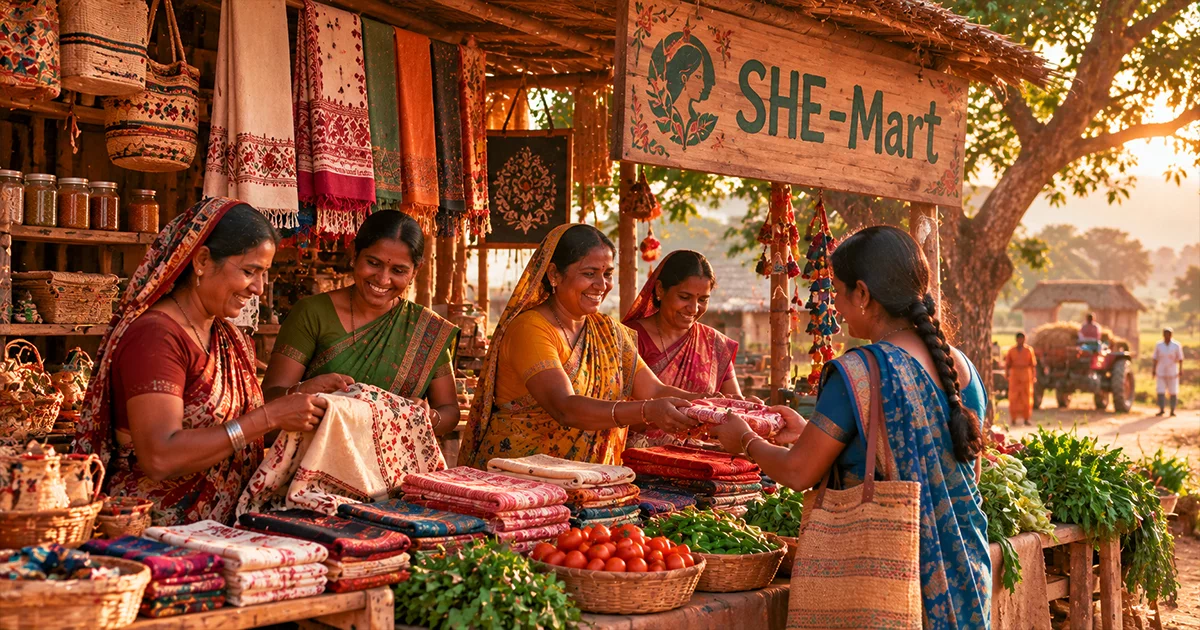
- SHE-Marts. These are community-owned retail outlets, set up through cluster-level federations of SHGs, meant to give women direct access to customers instead of relying on middlemen. The Ministry has planned roughly 700 SHE-Marts alongside 1,000 district fulfilment centres to support them.
- A shift toward enterprise ownership. The stated intent, in the Finance Minister’s own words during the budget speech, is to help women “take the next step from credit-linked livelihoods to being owners of enterprises” — meaning branding, packaging, and digital inventory support are now part of the package, not just loans.
The government also raised the overall Gender Budget by 11%, to more than ₹5 lakh crore, and is leaning on partnerships with ONDC (Open Network for Digital Commerce) to help SHE-Mart products reach buyers beyond their local area.
Who is eligible?
You qualify to work toward Lakhpati Didi status if you meet these conditions:
- You’re a woman between 18 and 50 years old
- You’re a member of a registered Self-Help Group (SHG) — if you’re not part of one yet, you can join through your nearest Gram Panchayat or Block Development Office (BDO)
- Your household hasn’t already crossed the sustainable ₹1 lakh/year threshold
Documents you’ll need:
- Aadhaar card
- PAN card
- Bank passbook
- Residence certificate
- An active mobile number (used for the LokOS App and SHG communication)
Applications can be submitted either online through the Ministry of Rural Development’s official portal, or offline at your local SHG office or bank branch.
One important clarification: this isn’t a scheme where any individual applies and simply receives ₹1 lakh. Eligibility and selection are tied to SHG participation, access to the Community Investment Fund, and involvement in ongoing livelihood activities — and states are allowed to layer on their own local criteria. Think of it less as a cash transfer and more as a structured pathway: join an SHG, access training and credit, build income over multiple cycles, and get certified once that income proves sustainable.
What kind of skill training is covered?
Beyond credit access, the scheme funds free skill training in trades that already have local demand — commonly cited examples include LED bulb assembly, plumbing, solar panel installation, and drone operation and repair (the “Drone Didi” component sits under this broader initiative). The idea is to pair the financial support with an actual income-generating skill, rather than credit alone.
Why this matters beyond the numbers
There’s a practical reason the government is pushing SHE-Marts and enterprise ownership so hard: credit alone doesn’t always translate into lasting income if there’s nowhere reliable to sell what you produce. A woman trained in tailoring or food processing still needs a market. SHE-Marts and the ONDC partnership are direct attempts to solve that second half of the problem — production support was already there; market access wasn’t, and that’s the gap 2.0 is trying to close.
Frequently Asked Questions
What is the current target for Lakhpati Didi Yojana?
6 crore women by March 2029, announced by the Prime Minister on August 15, 2026.
How many women have become Lakhpati Didis so far?
More than 3.46 crore, as of the Ministry of Rural Development’s July 2026 update.
What is the age limit to apply?
Women between 18 and 50 years old who are members of a Self-Help Group.
What is the new loan amount under Lakhpati Didi 2.0?
Up to ₹5 lakh, interest-free, available to individual SHG members through the LokOS App.
What are SHE-Marts?
Community-owned retail outlets run by cluster-level SHG federations, announced in Budget 2026-27 to give women direct market access for their products.
Is Lakhpati Didi a direct cash-transfer scheme?
No. It’s a structured livelihood program — women build income through SHG-linked credit, skill training, and enterprise support, and are certified once household income stays above ₹1 lakh a year for at least four consecutive seasons or business cycles.