Dengue Is No Longer a “Monsoon Disease” in India — And a Vaccine Is Finally Here

For decades, dengue in India followed a fairly predictable rhythm: cases would climb during the monsoon, peak in the weeks after heavy rains, and taper off as temperatures cooled. That pattern is breaking down. Hospitals in several cities reported rising suspected dengue cases even before this year’s monsoon officially began, and the numbers for 2026 tell a genuinely concerning story — alongside a piece of real, positive news: India’s first dengue vaccine has now been approved.
The numbers behind the “no more dengue season” story
According to the National Center for Vector Borne Diseases Control, India reported 6,927 dengue cases by the end of February 2026 alone — a figure that, on its own, already exceeded the entire January-May total recorded in 2021 (6,837 cases), and came close to matching the same period’s total from 2022 (10,172 cases). That’s an unusually early and unusually fast transmission pattern for a disease that used to reliably wait for the monsoon to really take hold.
The state-level picture through September reinforces this. Tamil Nadu has recorded 16,577 dengue infections and nine deaths so far this year, with roughly 200 new cases being detected daily as of mid-September — Chennai remains the worst-affected district, with 87 confirmed cases in a single day at one point, out of 156 fever patients hospitalized that day alone. The state has deployed more than 25,000 workers for mosquito-control and surveillance operations in response. Kerala, separately, reported 40 dengue deaths so far in 2026 as of early September, according to state health data. In Delhi, the Municipal Corporation had already logged 171 dengue cases well before the traditional monsoon peak, according to 2026 city data.
Why the pattern is actually changing?
Physicians tracking this shift point to a combination of factors rather than a single cause. Dr. Aubair Hussain, a Srinagar-based physician, explained that dengue transmission in India fluctuates sharply year to year based on population immunity following major outbreak seasons, shifts in which viral serotype is circulating, and local environmental conditions affecting mosquito breeding. After a high-transmission year, partial population immunity can temporarily suppress case counts — but, as Dr. Hussain noted, this doesn’t interrupt the longer-term trend, it just creates short-term dips within an overall upward pattern.
Rising temperatures, shifting rainfall patterns, and increasing urbanization are the three factors most consistently cited by Indian health officials as driving dengue’s shift from a clearly seasonal disease into something closer to a year-round threat. Warmer temperatures for longer stretches of the year extend the window during which Aedes mosquitoes, the primary carriers of the dengue virus, can breed and transmit effectively — meaning the “safe” months between monsoon seasons are genuinely shrinking.
The real piece of good news: India’s first dengue vaccine
Simultaneously with this worrying trend, there is also a very positive and major one: the world of India has officially given the green light to the launch or deployment of the world’s first dengue vaccine, Qdenga. The vaccine was developed through a partnership between Dr. Reddy’s Laboratories and Japanese pharmaceutical company Takeda, which will soon bring this new drug to the Indian community. The rollout is scheduled for the early part of 2027. According to the vaccine manufacturer, it’s for 4 to 60 years old. Two doses should be enough. The vaccine has been developed to target protection against all four dengue virus serotypes. Why is this important? Because dengue’s four distinct serotypes are the very reason why building long-lasting and comprehensive immunity has been difficult to date, and the reason why dengue infection more than once in a person’s life is possible.
We need to look at the situation objectively: vaccine approval is a major achievement, but since distribution is scheduled for the first half of 2027, it is unlikely to have any meaningful impact on transmission over the next two years. The process of vaccination also requires a long time to achieve a population-level of protection that is statistically significant, even after the actual distribution is done. Hence, Qdenga’s approval can be considered a very important long-term change rather than a sudden one that affects the situation at the 2026-27 dengue season level.
What this means for you right now?
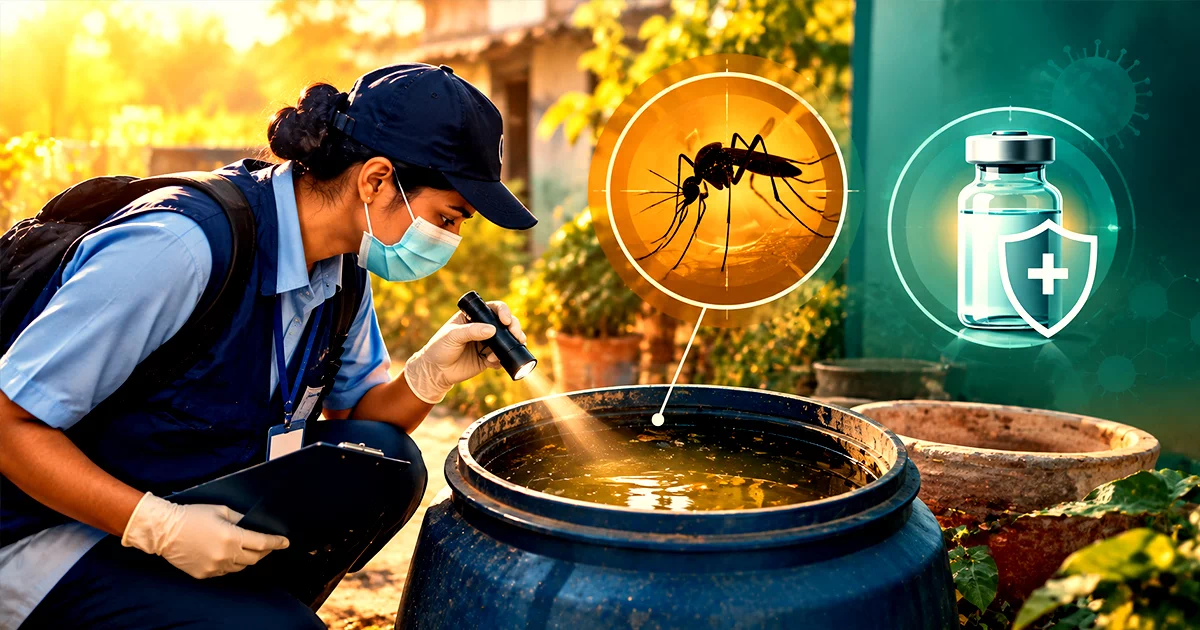
Because dengue transmission is increasingly active well outside the traditional monsoon window, the practical takeaway is to maintain standard mosquito-prevention precautions across a longer stretch of the year, rather than treating them as a monsoon-specific concern. That means routinely checking for and eliminating standing water around homes — even small amounts in flower pots, coolers, or discarded containers are enough for Aedes mosquitoes to breed — using mosquito repellents and nets, and wearing long sleeves during peak mosquito activity hours, typically early morning and dusk.
It’s also worth knowing the warning signs that warrant urgent medical attention rather than just home management: high fever accompanied by severe headache, pain behind the eyes, joint and muscle pain, persistent vomiting, bleeding gums, or a rash are all reasons to seek medical care promptly rather than waiting it out, since dengue can progress to more severe forms requiring hospitalization, particularly in children, elderly people, and those with pre-existing health conditions.
The bigger picture
What we are seeing with dengue spreading in India is in fact typical and part of a wider pattern noticed by public health experts for many years in South and Southeast Asia: a longer window of transmission for vector-borne diseases resulting from shifts in regional climate patterns, not because of the problem being confined to the country where it started.
To give an example, Sri Lanka reported almost 98,000 dengue cases and 74 deaths for the same 2026 year, the numbers having remained relatively high and the government there issuing similar warnings of possible increase as the monsoon rain season could be bringing dengue-cases back even after the main spike of the year is over.India, for one, faces the situation where there is actually a longer transmission period, which is the country’s introduction to denga vaccine on the one hand and these two together represent a challenge to public health which is real, worsening, and, on the other hand, being tackled with the very first proper long-term solution tool – a fact even though that solution’s full effectiveness is not yet felt and probably a couple of years away.
Pictures, charts and maps of this article are just general knowledge, not professional guidance. You should contact a qualified person if, for example, you suspect you contracted dengue or have fears of being at risk, don’t trust your own judgment and self diagnose.