NSC Interest Rate 2026: National Savings Certificate Rate, Maturity and Tax

The NSC interest rate for 1 October to 31 December 2026 is 7.7% a year, compounded yearly and paid in one go when the certificate matures after five years. Rs 1,000 grows to about Rs 1,449, and Rs 1 lakh grows to about Rs 1,44,903.
The Ministry of Finance kept every small savings rate unchanged for this quarter in an office memorandum dated 30 September 2026, which the Department of Posts circulated to post offices in SB Order No. 12/2026. Below you will find the maturity table, the Section 80C rules (including the reinvested interest deduction), who can buy a National Savings Certificate, early closure, pledging and a comparison with PPF, KVP and the post office FD.
NSC interest rate 2026: October-December quarter
The National Savings Certificate (VIII Issue) earns 7.7% a year, “payable at maturity (compounded yearly)”, according to India Post’s savings schemes page. The government rate table, as reported by The Economic Times, puts the maturity value at Rs 14,490 for every Rs 10,000.
The NSC interest rate is reviewed every quarter, but the rate on the day you buy stays fixed for the full five years, even if later reviews cut it.
NSC maturity value for Rs 1,000 and Rs 1 lakh
At 7.7%, Rs 1,000 becomes Rs 1,449 after five years, and Rs 1 lakh becomes Rs 1,44,903. The interest is added to the balance each year and compounds, but you receive nothing until maturity.
| Year | Interest on Rs 1,000 | Interest on Rs 1 lakh | Value of Rs 1 lakh at year end |
|---|---|---|---|
| Year 1 | Rs 77.00 | Rs 7,700 | Rs 1,07,700 |
| Year 2 | Rs 82.93 | Rs 8,293 | Rs 1,15,993 |
| Year 3 | Rs 89.31 | Rs 8,931 | Rs 1,24,924 |
| Year 4 | Rs 96.19 | Rs 9,619 | Rs 1,34,544 |
| Year 5 | Rs 103.60 | Rs 10,360 | Rs 1,44,903 |
The formula is simple: Maturity value = P x (1 + 0.077)^5. Total interest on Rs 1 lakh is about Rs 44,903 before tax. Figures are our own calculation at 7.7%, rounded.
NSC eligibility: who can buy a National Savings Certificate?
Any resident Indian adult can buy one at a post office. The National Savings Certificates (VIII Issue) Scheme, 2019 (G.S.R. 919(E), dated 12 December 2019) allows three account types:
- Single holder: an adult for himself or herself, a guardian on behalf of a minor or a person of unsound mind, or a minor aged 10 or more in his or her own name.
- Joint A: up to three adults, paid to all holders jointly or to the survivor.
- Joint B: up to three adults, paid to any one holder or to the survivor.
The minimum is Rs 1,000, with further amounts in multiples of Rs 100. There is no upper limit, and you can open any number of accounts. India Post’s savings schemes e-book lists the documents: two passport-size photos, Aadhaar and PAN (or Form 60). You can also buy NSC through India Post internet banking if you hold a post office savings account. Nomination is allowed.
NSC tax benefit: Section 80C and the reinvested interest deduction
The amount you invest in NSC qualifies for the Rs 1.5 lakh deduction people know as Section 80C, but only under the old tax regime. For FY 2026-27, that deduction is Section 123 of the Income-tax Act, 2025, with the same Rs 1.5 lakh cap, as Finfod’s guide explains.
Is NSC interest taxable?
Yes. NSC interest is taxable at your slab rate, and no TDS is deducted, so you have to report it yourself.
There is a twist. Paragraph 5 of the scheme says the interest for years one to four is “deemed to have been reinvested” in the certificate. Because of this, that interest has traditionally counted as a fresh 80C investment, so it can be claimed as a deduction in the same year it is added to income, within the Rs 1.5 lakh cap, as Groww’s NSC guide notes. Fifth-year interest is not reinvested, so it is simply taxed. On Rs 1 lakh, that means Rs 7,700, Rs 8,293, Rs 8,931 and Rs 9,619 can be claimed in years one to four, while Rs 10,360 in year five is fully taxable.
Under the new regime, which is now the default, none of this deduction is available, though the 7.7% return is the same.
Can NSC be closed before 5 years?
Generally, no. Paragraph 7 of the scheme allows early closure only on the death of the holder (or any joint holder), on forfeiture by a pledgee who is a Gazetted Officer, or when a court orders it.
- Before 1 year: only the principal is paid back.
- After 1 year but before 3 years: principal plus post office savings account interest (currently 4%) for completed months.
- After 3 years: a fixed amount from the scheme’s table for each six-month band, which is less than full NSC interest.
If you do not claim the money at maturity, India Post’s e-book says post-maturity interest is paid at 4%.
Can I take a loan against NSC?
Yes. You can pledge an NSC as security on Form 3 with an acceptance letter from the lender. Under paragraph 6, eligible pledgees include the RBI, scheduled banks, co-operative banks and societies, public or private corporations, government companies, local authorities and housing finance companies approved by the National Housing Bank. A minor’s certificate can be pledged only if the guardian certifies in writing that the minor is alive and that the pledge benefits the minor.
NSC interest rate vs PPF, KVP and FD: which is better?
At 7.7%, the NSC interest rate is the highest of the four, but its interest is taxable. PPF pays less and is tax-free throughout.
| Feature (1 Oct-31 Dec 2026) | NSC | PPF | KVP | Post office 5-year FD (TD) |
|---|---|---|---|---|
| Interest rate | 7.7%, compounded yearly | 7.1%, compounded yearly | 7.5%, compounded yearly | 7.5%, compounded quarterly, paid yearly |
| Tenure | 5 years | 15 years | 115 months (doubles) | 5 years |
| Rate fixed for full term? | Yes | No, changes each quarter | Yes | Yes |
| 80C deduction (old regime) | Yes | Yes | No | Yes |
| Interest tax | Taxable | Tax-free | Taxable | Taxable |
| Rs 1 lakh after 5 years | Rs 1,44,903 (at maturity) | Not comparable: yearly deposits, 15-year lock-in | Still running; doubles to Rs 2 lakh at 115 months | Rs 1,38,570 (interest paid out yearly) |
Rates are from India Post and the Ministry of Finance memorandum; the TD figure is from our post office FD interest rate guide. PPF is a yearly-deposit account rather than a lump sum, so read the full PPF interest rate rules before comparing. For retirees, the Senior Citizen Savings Scheme pays 8.2% with quarterly income, and parents of a girl under 10 can get 8.2% tax-free through Sukanya Samriddhi Yojana.
Frequently asked questions
What is the NSC interest rate today?
7.7% a year for certificates bought between 1 October and 31 December 2026, fixed until maturity.
How much is Rs 10,000 in NSC after 5 years?
About Rs 14,490, which is the figure in the government’s rate table.
Is NSC safe?
Yes. It is a Government of India small savings scheme notified under the Government Savings Promotion Act, 1873, and sold through post offices.
Sources: India Post, savings schemes; NSC (VIII Issue) Scheme, 2019; SB Order 12/2026 and Ministry of Finance OM, 30 September 2026; Upstox, October-December 2026 rates. Rates change every quarter; confirm at your post office before you invest. This is general information, not financial or tax advice.
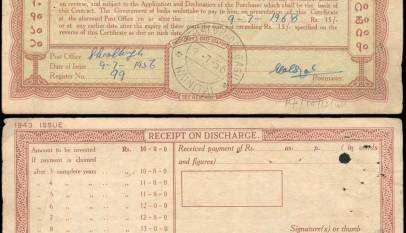
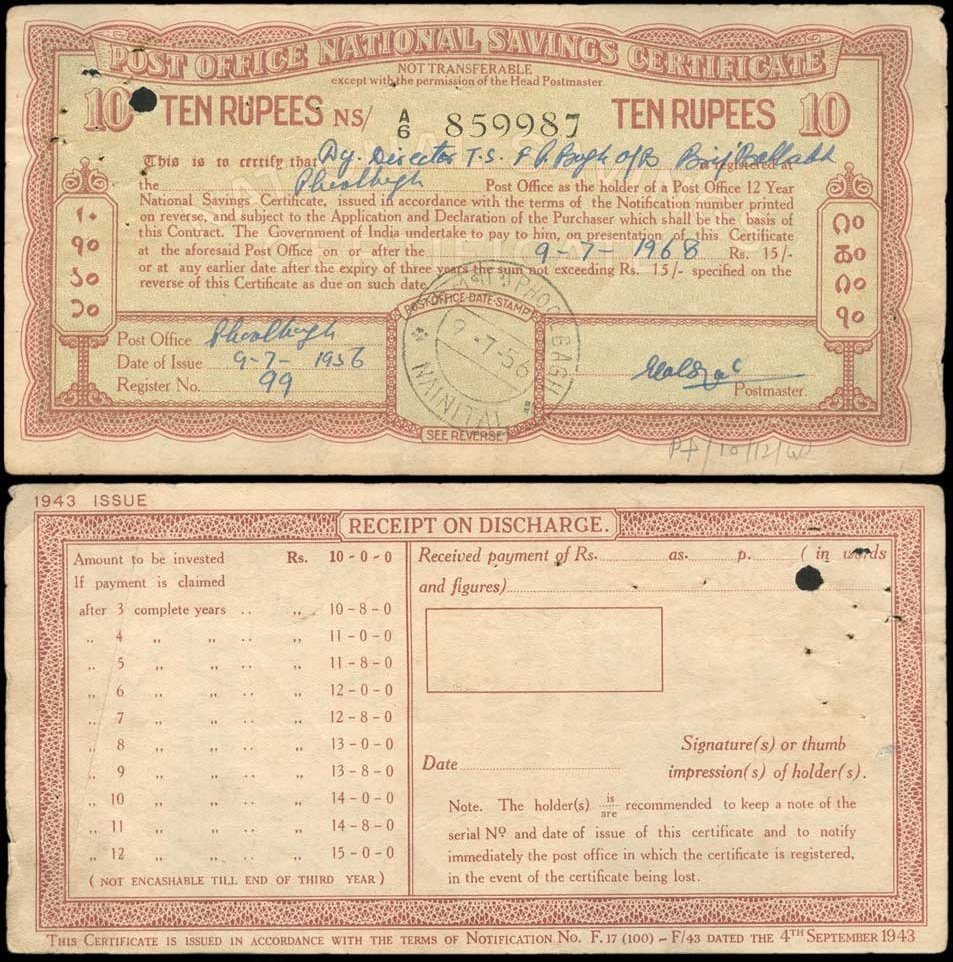
Featured image: Government of India / Wikimedia Commons, public domain. A 1956 Rs 10 Post Office National Savings Certificate, front and back; historical, not the current VIII Issue.