Delhi’s Pink Saheli Card: The Paper Ticket Era Is Officially Over

For years, free bus travel for women in Delhi ran on a simple paper system — a zero-value pink ticket, handed out ride by ride since 2019. That era has now formally ended. As of this month, the paper pink ticket has been fully replaced by a digital smart card, with nearly 1.9 million cards already issued. Here’s what’s actually changed, and what you need to know if you haven’t made the switch yet.
The timeline, from announcement to mandatory switch
The Saheli Pink Smart Card scheme was formally launched on March 2, 2026, in the presence of President Droupadi Murmu, with card distribution beginning the very next day. The transition away from paper tickets happened in stages rather than all at once: the Delhi government initially set September 17, 2026, as the last day the old paper pink ticket would be valid, before the digital card became mandatory. In practice, reporting shows the transition stretched slightly beyond that date, with paper tickets confirmed to be fully phased out by October, and Transport Minister Pankaj Kumar Singh confirming on October 2 that free DTC bus rides now require the Pink Saheli smart card.
As of early October, Delhi Chief Minister Rekha Gupta reported that distribution had crossed 18.75 lakh cards, with transport officials separately citing a figure near 1.9 million — slightly different counts likely reflecting different reporting dates during a fast-moving rollout, but both confirming the same basic picture: the overwhelming majority of regular women bus riders in Delhi have already made the switch.
Who’s eligible, and what you actually need?
The scheme covers women and transgender residents of Delhi aged five or older — a notably broad and inclusive eligibility bar compared to many government transit benefit schemes. You can apply either offline at designated DTC distribution centres, or online through MufinPay, using your Aadhaar card and a registered mobile number.
The first card is issued completely free of cost. If you lose it or need a replacement, that costs ₹59 — a modest fee specifically designed to prevent casual card loss and reissue requests from becoming a significant administrative and cost burden on the scheme, while still keeping replacement genuinely affordable for anyone who actually needs one.
What the card actually does, and where it works?
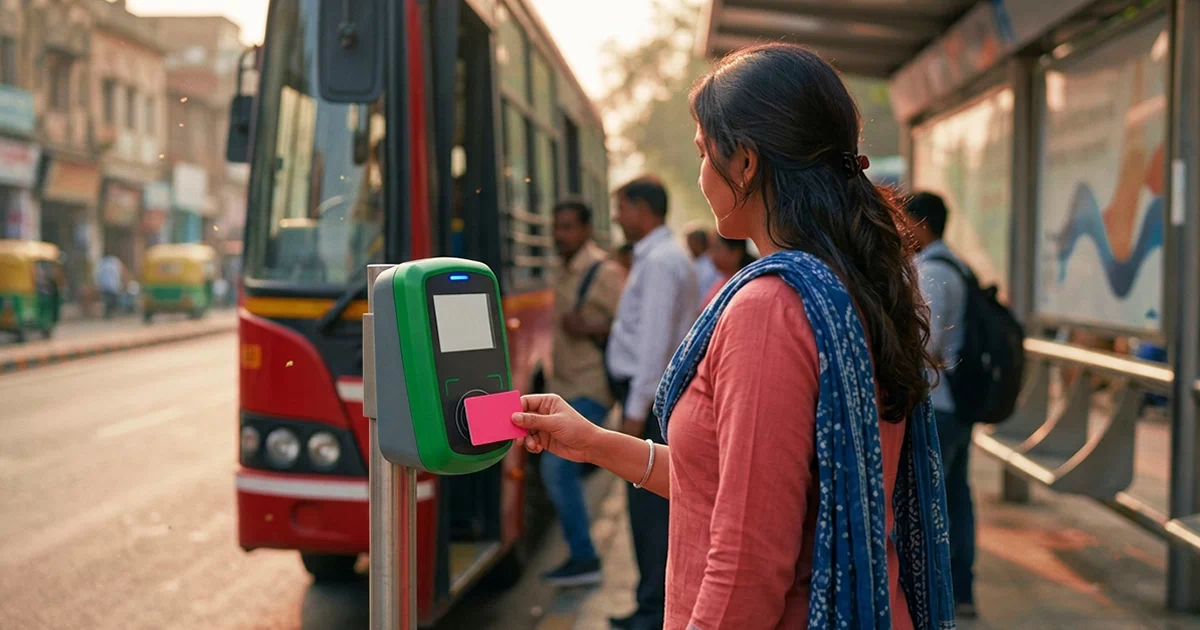
The core benefit is straightforward: free travel on DTC and Cluster buses for eligible cardholders, simply by tapping the card rather than requesting and holding a paper ticket for each individual ride. But the card’s design goes meaningfully beyond just bus travel. It’s built on the NCMC (National Common Mobility Card) standard, meaning it’s designed to be interoperable across multiple transit systems rather than locked to buses alone.
If you want to use the same card on the Delhi Metro or the RRTS (Regional Rapid Transit System), you can top it up by scanning the QR code printed on the back of the card through any UPI payment app — a genuinely convenient, modern mechanism that doesn’t require a separate dedicated recharge process. For Delhi Metro specifically, the balance needs to be loaded through an Add Value Machine (AVM) located at metro stations, a slightly different mechanism from the UPI QR top-up used elsewhere, worth knowing before you assume the exact same top-up method works everywhere the card is accepted.
Why Delhi moved away from paper tickets in the first place?
The stated rationale behind digitizing what had been a simple paper-based system centers on three goals: transparency, security, and building a more technology-driven public transport system generally. A paper ticket system, however simple, is genuinely difficult to audit at scale — there’s no clean way to verify exactly how many free rides are being provided, track usage patterns, or prevent misuse, compared to a digital card system that generates a verifiable transaction record with every tap.
There’s also a practical administrative angle worth understanding: a physical, reusable smart card eliminates the ongoing printing, distribution, and verification overhead that a continuously replenished paper ticket system requires, while giving transit authorities meaningfully better data on actual ridership patterns among the specific population the scheme serves.
What to do if you haven’t switched yet?
If you’re a Delhi-based woman or transgender resident who’s been relying on the free bus travel benefit and haven’t yet obtained a Pink Saheli card, the practical next step is straightforward: visit a DTC distribution centre with your Aadhaar card, or apply through MufinPay online, during the transition period transport officials have described as a roughly 10-day adjustment campaign aimed at helping remaining riders make the switch smoothly. Given that paper tickets are no longer being accepted for free travel as of early October, getting the card sorted promptly is worth prioritizing if continued free bus access matters for your regular commute.
The bigger picture
Delhi’s shift here fits into a broader, consistent pattern across Indian public transit over the past several years: state governments digitizing benefit and subsidy delivery systems that used to run on paper, aiming to improve accountability, reduce fraud, and generate usable data on who’s actually benefiting from a given scheme. Whether this specific transition proves smooth for the remaining riders still completing the switch will likely depend heavily on how well DTC’s distribution infrastructure holds up now that the paper fallback option is genuinely gone, rather than just technically phased out on paper.
Scheme details, deadlines, and card distribution figures are based on official statements from Delhi’s Transport Ministry as of the time of writing and may be updated as the rollout continues. Check the DTC’s official channels for current application details.