Senior Citizen Savings Scheme 2026: SCSS Interest Rate 8.2%, Rules and Tax

The Senior Citizen Savings Scheme (SCSS) is a government-backed post office and bank deposit for people aged 60 and above, and for some early retirees. You put in a lump sum once, and it pays you interest every quarter for five years. For the October to December 2026 quarter, the SCSS interest rate is 8.2% a year, which works out to Rs 205 every quarter for each Rs 10,000 you deposit.
That rate is listed on India Post’s savings schemes page. On 30 September 2026, the Department of Economic Affairs kept all small savings rates unchanged for 1 October to 31 December 2026, as reported by The Economic Times. Here are the rules, a worked example and the tax points.
Senior Citizen Savings Scheme at a glance
| Feature | Rule |
|---|---|
| Interest rate (1 Oct to 31 Dec 2026) | 8.2% a year, paid every quarter |
| Who can open | Age 60+; retirees aged 55 to 60; retired defence personnel aged 50+ |
| Minimum deposit | Rs 1,000, in multiples of Rs 1,000 |
| Maximum deposit | Rs 30 lakh across all your SCSS accounts |
| Tenure | 5 years, extendable in blocks of 3 years |
| Account type | Single, or joint with your spouse only |
| Early closure | Allowed any time, with a penalty |
| Tax | Deposit qualifies for 80C (old regime); interest is taxable |
What is the SCSS interest rate for October-December 2026?
The SCSS interest rate is 8.2% per annum for accounts opened between 1 October and 31 December 2026. Interest is calculated and paid quarterly, and it is not compounded inside the account.
Rates are reviewed every quarter; the January-March 2027 rate is due by end-December. Unlike PPF, your opening rate stays fixed for the full five years. According to SBI’s SCSS page, 8.2% has applied since 1 April 2023. If you extend the account, the extended block earns the rate in force on the maturity date.
How is SCSS interest calculated? A worked example
Quarterly interest is simply the deposit multiplied by 8.2% and divided by 4. Take a deposit of Rs 10 lakh:
- Yearly interest: Rs 10,00,000 x 8.2% = Rs 82,000
- Quarterly interest: Rs 82,000 / 4 = Rs 20,500
- Over five years: Rs 20,500 x 20 quarters = Rs 4,10,000
You get the Rs 10 lakh back at maturity, so total payouts come to Rs 14,10,000 before tax.
| Deposit | Every quarter | Every year | Over 5 years |
|---|---|---|---|
| Rs 1 lakh | Rs 2,050 | Rs 8,200 | Rs 41,000 |
| Rs 5 lakh | Rs 10,250 | Rs 41,000 | Rs 2,05,000 |
| Rs 10 lakh | Rs 20,500 | Rs 82,000 | Rs 4,10,000 |
| Rs 15 lakh | Rs 30,750 | Rs 1,23,000 | Rs 6,15,000 |
| Rs 30 lakh (maximum) | Rs 61,500 | Rs 2,46,000 | Rs 12,30,000 |
Figures are before tax. The first payment is usually smaller. India Post’s savings schemes leaflet says the first interest runs from the deposit date to the end of that quarter. After that, it is paid on 1 April, 1 July, 1 October and 1 January. So an account opened in mid-November gets a part-quarter payment on 1 January, then full quarters after that.
Unclaimed interest earns nothing extra, so have it credited to a savings account. If you need a payout every month instead, the Post Office Monthly Income Scheme pays 7.4% this quarter and is open to any adult.
Who is eligible for the Senior Citizen Savings Scheme?
Any resident Indian aged 60 or above can open an SCSS account. Two younger groups also qualify, under the Senior Citizen’s Savings (Fourth Amendment) Scheme, 2023, notified on 7 November 2023 and circulated by India Post in SB Order 22/2023:
- Retirees aged 55 to 60 who have retired on superannuation or otherwise, which includes voluntary retirement (VRS) and special VRS. They must invest within three months of receiving their retirement benefits and attach proof of the payout and an employer certificate.
- Retired defence personnel (excluding civilian defence employees) from the age of 50, subject to the other conditions.
- The spouse of a government employee who died in harness after turning 50, subject to the other conditions.
“Retirement benefits” covers PF dues, gratuity, commuted pension, leave encashment and VRS ex-gratia. NRIs and HUFs cannot open an account. A joint account can only be held with your spouse, and the whole deposit counts against the first holder’s Rs 30 lakh limit.
How much can you invest in SCSS?
You can invest from Rs 1,000 up to Rs 30 lakh, in multiples of Rs 1,000. You can hold more than one account, but the Rs 30 lakh cap covers all of them together.
The India Post leaflet says you can pay up to Rs 1 lakh in cash; above that, pay by cheque or NEFT. Above Rs 10 lakh, you must show the source of funds, such as a bank statement or three years of tax returns. You also need two photographs, Aadhaar and PAN.
SCSS tenure and the 3-year extension
An SCSS account matures five years after opening. Since the November 2023 amendment, you can extend it for another three years as many times as you like. Apply on Form-4 within one year of maturity or the end of each block. The extension counts from the maturity date and earns the rate in force then.
What happens if you close SCSS early?
You can close the account at any time, but the penalty depends on how long it has run:
- Before 1 year: no interest at all; any interest already paid is recovered from the deposit.
- After 1 year but before 2 years: 1.5% of the deposit is deducted.
- After 2 years but before 5 years: 1% of the deposit is deducted.
- Extended account closed within 1 year of extension: 1% of the deposit is deducted.
On a Rs 10 lakh deposit, that is Rs 15,000 if you close in the second year and Rs 10,000 in years three to five. If the account holder dies, the account is closed and paid to the nominee. A spouse who is the joint holder or sole nominee can continue it if they are eligible themselves.
Is SCSS interest taxable?
Yes. SCSS interest is added to your income and taxed at your slab rate. Only the deposit gets a deduction.
- Deduction: the deposit qualifies under the Rs 1.5 lakh limit known as Section 80C, now Section 123 of the Income-tax Act, 2025 for FY 2026-27, as Finfod’s guide explains. It applies only under the old tax regime.
- TDS: for senior citizens, the TDS threshold for interest from a bank or post office is Rs 1 lakh a year per payer. Above that, 10% is deducted, according to TaxGuru’s TDS table for 2026-27. At 8.2%, a deposit of about Rs 12.19 lakh earns just under Rs 1 lakh a year.
- Form 15H is now Form 121: from 1 April 2026, if your total income is below the taxable limit, you file Form 121 instead of the old Form 15H to stop TDS, as The Wealth Blog explains. Ask your post office which form it currently accepts.
If tax-free returns matter more to you than quarterly income, compare SCSS with the PPF interest rate of 7.1%. It pays less, but its interest is fully exempt.
How to open a Senior Citizen Savings Scheme account
Visit any post office or an authorised bank such as SBI with the account opening form, KYC documents, photographs and the deposit. Retirees under 60 should also bring the employer certificate and proof of the retirement payout date. Name a nominee when you open the account.
If you draw a pension, also submit your life certificate for 2026 by 30 November. Those aged 70 or above can get free hospital cover of up to Rs 5 lakh a year through the Ayushman Vaya Vandana Card.
Frequently asked questions
Can I open SCSS at 58 after taking VRS?
Yes, if you invest within three months of receiving your retirement benefits and submit the employer certificate.
Can husband and wife both open SCSS accounts?
Yes. Each spouse can have their own accounts up to Rs 30 lakh, and the two can also hold joint accounts with each other.
Sources: India Post, savings schemes; India Post savings schemes leaflet; India Post SB Order 22/2023 with Gazette notification G.S.R. 829(E); SBI, Senior Citizens Savings Scheme; The Economic Times, 30 September 2026. Rates and rules can change. Check with your post office or bank before investing. This is general information, not financial advice.
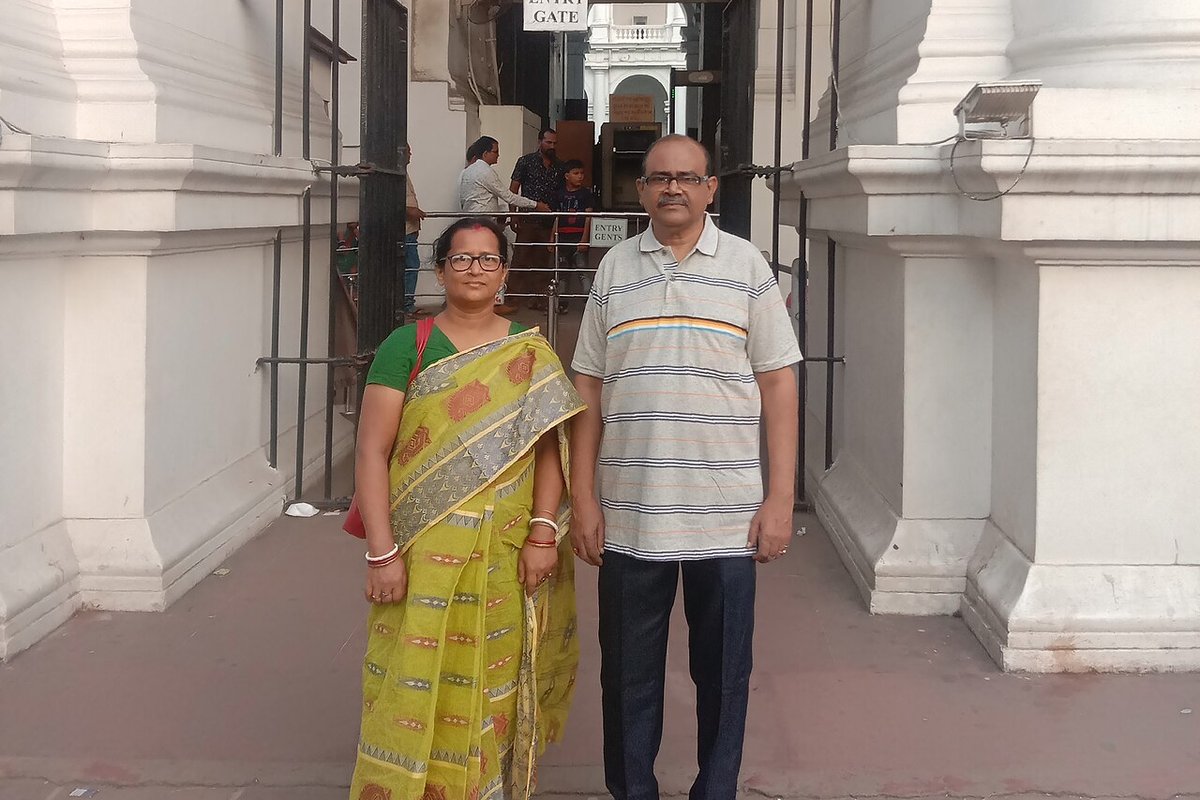
Featured image: Billjones94 / Wikimedia Commons, CC0 (cropped and resized). An elderly couple outside the Indian Museum, Kolkata.