The 2026 Nobel Prizes, Explained Without the Jargon

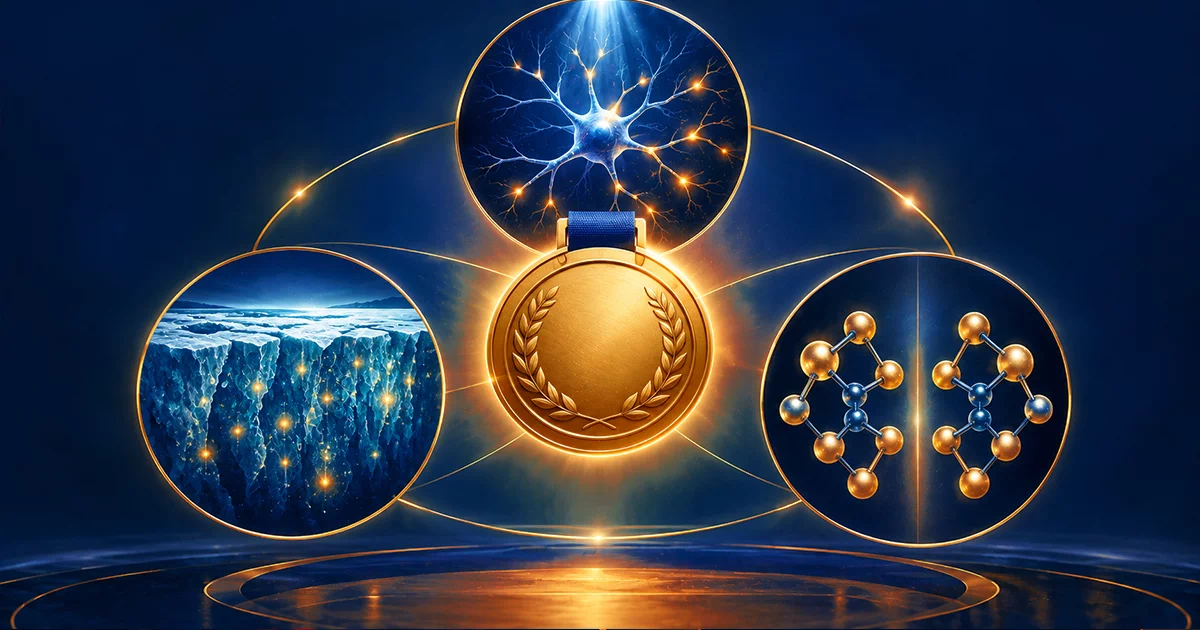
Every October, the world gets a handful of announcements from Stockholm and Oslo, and most of us read the headline, nod, and move on without really knowing what was just honoured. This year’s winners deserve better than that. Three of the science prizes went to work that sounds almost like science fiction: switching brain cells on with light, catching ghostly particles under Antarctic ice, and explaining why life’s molecules all seem to face the same direction. Here is what each of them actually means, in plain language.
Medicine: using light to control the brain
The Nobel Prize for Physiology or Medicine was awarded to Karl Deisseroth, Peter Hegemann, and Georg Nagel for uncovering a new technique, optogenetics. This news was announced on Monday, October 5.
This is the basic concept: Hegemann and Nagel from Germany had identified light -sensitive proteins that the green algae uses to guide it towards light source, single cell organisms that have them. These proteins work as microscopic gates that open up upon exposure to light. Deisseroth, who is both psychiatrist and bioengineer at Stanford, was inspired to try inserting such microscopic gates into the cell membrane in order to have the ability to control the cell’s activity by a pulse of light.
Why is it important? In their statement the panel described that the researchers had long been seeking to figure out how the brain creates memories, emotions and conducts activities. Before the optogenetic technology one possibility was that scientists could observe the brain’s activity or, alternatively, they were trying brain stimulation through the electrodes, but that made it very hard to activate a single kind of cell, and then, to watch what changes that would cause. Today they can. According to the president of the Nobel committee, Per Svenningsson, optogenetics is a powerful tool that will allow mapping brain activity at the level that previously seemed impossible.
However, it should be noted that optogenetics is, for now, mostly a lab-based approach, it is animals that are the primary subjects for research and that help us understand brain function. It is not something to discuss with a physician. Even so, it has completely changed the way scientists carry out brain research.
Physics: ghost particles from deep space
The physics prize went to Francis Halzen, announced on Tuesday, October 6, for his decisive contributions to the IceCube Neutrino Observatory and the discovery of high-energy neutrinos that come from beyond our solar system.
Neutrinos are very peculiar. They are small subatomic particles that are not electrically charged, and they literally get through everything, like the planet Earth and even through your body, without any trace left. Billions of them come through your thumbnail every second. That ethereal property makes them almost undetectable, however it also allows them to be excellent messengers. When light of cosmic phenomena far away reaches us, it is absorbed or scattered on the way. Neutrinos go in straight lines and arrive without change, telling us about some extremely violent regions in the Universe.
IceCube solves the catching problem in a dramatic way. It’s a detector built into a cubic kilometre of Antarctic ice at the South Pole. When a rare neutrino bumps into an atom in the ice, it produces a faint flash of blue light, and thousands of sensors buried deep in the ice pick it up. Halzen was a driving force behind building it and making it work. The prize recognises that this experiment didn’t just detect neutrinos, it found ones from outside our galaxy, opening a new way of looking at the cosmos.
Chemistry: the mirror-molecule mystery
The chemistry prize went to Henri B. Kagan and Kenso Soai, announced on Wednesday, October 7, and it comes with 12 million Swedish kronor, about $1.2 million. It’s the hardest of the three to picture, so let’s try an analogy.
Your left and right hands are mirror images of each other, but you can’t perfectly overlay one on top of the other. Many molecules work the same way: they come in a “left-handed” and a “right-handed” form. Strikingly, life uses only one of the two. The amino acids in your proteins are almost all left-handed, and the sugars in your DNA are right-handed. Why nature picked one hand, and how that preference could have started in the first place, has been a puzzle for more than a century, the Nobel committee noted.
Kagan helped develop the tools chemists use to make just one hand of a molecule on purpose, which matters enormously in making medicines, because the two hands of the same molecule can behave very differently in the body. Soai discovered a remarkable reaction in which a tiny, almost undetectable imbalance in one hand gets amplified into a large one, with no outside push. That is a possible clue to how life’s one-handedness could have begun from almost nothing. The committee said their work gave chemists widely used everyday tools and also stirred fresh interest in the chemistry of life’s origins.
Literature and Peace
In this year’s literary field, the prize went to the poet and classicist in the same country as Canada Anne Carson. The winner of the Nobel Peace Prize who was announced on Friday, October 9, is an advocate of human rights, Navanethem “Navi” Pillay. The announcements for the Peace Prize most often generate heated discussion, so it’s better to get a detailed explanation of it from the committee through nobelprize.org instead of being based purely on a news headline summary that captures only part of the actual reason.
What about economics?
The Nobel announcements run from October 5 to October 12, which means the economics prize is due to be announced today. We’ll leave it out of this piece rather than guess; check the official Nobel Prize website for the winner and the reasoning.
Why these prizes are worth caring about
It’s easy to think of Nobel science as remote from daily life, but the pattern across this year’s three science prizes is interesting. In every case, the winning idea began as curiosity about something odd: why algae swim toward light, what happens when a particle slips through a mountain of ice, why molecules come in matching pairs. None of those questions looked practical when they were first asked. Optogenetics is now a standard tool for brain research, the one-handedness work feeds directly into how medicines are designed, and neutrino astronomy is still young but already giving astronomers something they never had before.
That’s the quiet argument these prizes keep making: foundational research is slow, unglamorous, and often decades from any obvious payoff, but it’s where a lot of the future comes from.
Prize details are based on announcements from the Nobel committees as of October 12, 2026. For official citations and any later announcements, check nobelprize.org.